The Honeywell T5 smart thermostat remains a solid choice for homeowners looking to upgrade their HVAC control without very costly. It’s not flashy, but it delivers where it counts: reliable scheduling, straightforward app control, and compatibility with most heating and cooling systems. Whether you’re swapping out an old mechanical dial or upgrading from a basic programmable model, the T5 offers a practical step into smart home climate control. This guide walks through what sets it apart, how to install it yourself, and whether it’s the right fit for your home.
Table of Contents
ToggleKey Takeaways
- The Honeywell T5 smart thermostat offers reliable scheduling, geofencing, and app control at an affordable $80–$120 price point, making it ideal for budget-conscious homeowners upgrading from basic programmable models.
- The T5 features a straightforward non-touchscreen interface with physical buttons, works with most standard 24-volt HVAC systems (gas, oil, electric, and heat pumps), and can be installed by DIYers in 20–30 minutes.
- Flexible 7-day scheduling with up to four temperature periods per day and location-based geofencing can save homeowners up to $180 annually on heating and cooling costs without monthly subscription fees.
- The T5 requires a C-wire for stable operation and supports 2.4 GHz Wi-Fi with voice control through Alexa, Google Assistant, and Apple HomeKit, though advanced automation is less robust than premium competitors.
- The thermostat is best suited for single-zone homes with standard HVAC systems; those needing room sensors, touchscreen displays, or complex multi-zone setups should consider higher-end models like the T9 or T10.
What Makes the Honeywell T5 Smart Thermostat Stand Out?
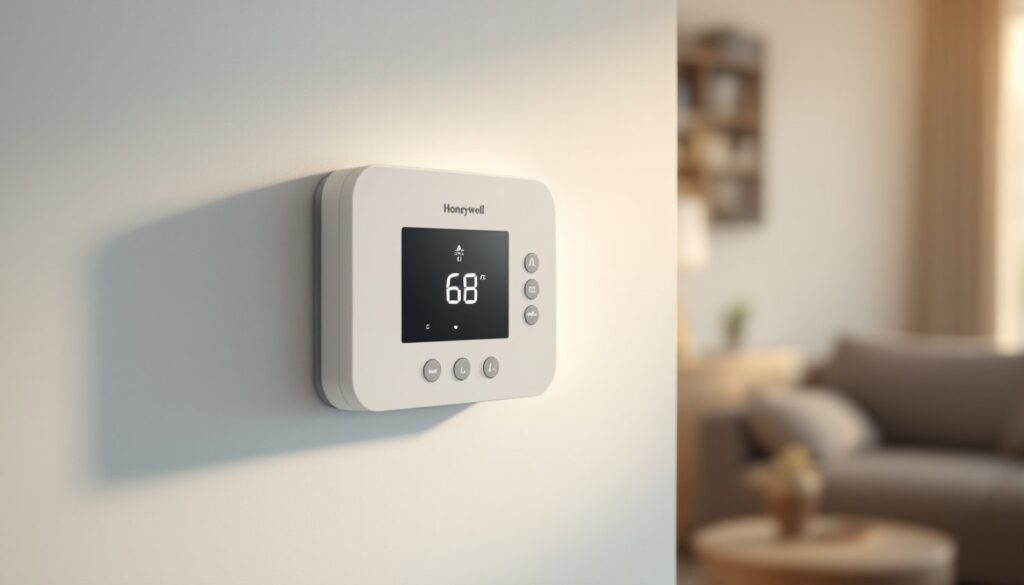
The T5 sits in the middle of Honeywell’s smart thermostat lineup, above the basic RTH models but below the touchscreen T9 and T10 series. Its primary advantage is simplicity. The interface is straightforward: a small backlit screen with physical buttons instead of a touchscreen. That makes it easier to use with gloves on or if you prefer tactile controls.
It works with most 24-volt HVAC systems, including gas, oil, and electric forced air, as well as heat pumps (with or without auxiliary heat). It handles up to two stages of heating and two stages of cooling, plus a single-stage heat pump with aux heat. If you’ve got a boiler with zone valves, a millivolt system, or a high-voltage setup, you’ll need a different model or possibly a professional installation with a relay.
The T5 doesn’t include a room sensor like the pricier T9, and it lacks some of the advanced learning features you’d find in a Nest or Ecobee. But that’s also why it’s less expensive and why setup takes minutes, not hours.
Key Features and Smart Capabilities
Scheduling and Geofencing
The T5 supports 7-day flexible scheduling through the Honeywell Home app. You can set different temperature schedules for each day of the week, with up to four periods per day (wake, leave, return, sleep). This beats the old 5-2 programmable thermostats that only let you differentiate weekdays from weekends.
Geofencing uses your smartphone’s location to adjust the temperature when you leave or return home. It’s not as refined as some competitors, there’s no learning algorithm, but it works reliably if you keep location services enabled. You set a radius around your home (typically 1–7 miles), and the thermostat shifts to an away temperature when you cross that boundary.
Display and Interface
The non-touchscreen display shows current temperature, set point, and system status. It’s a 2.5-inch monochrome screen, nothing fancy, but perfectly readable in any light. Navigation uses five physical buttons: up/down arrows, a menu button, and selection controls. It’s slower than swiping on a touchscreen but more durable and less prone to accidental changes.
Compatibility Notes
The T5 requires a C-wire (common wire) for power in most installations. If your old thermostat didn’t use one, you might have a spare wire tucked behind the wall plate, check before you buy. If not, you can add a C-wire adapter (Honeywell sells one, or use a third-party model), run a new wire from the furnace, or hire an HVAC tech. Skipping the C-wire will cause intermittent connectivity issues or a dead display.
It supports Wi-Fi (2.4 GHz only), not 5 GHz. Many routers broadcast both, but you’ll need to ensure your network’s 2.4 GHz band is active and not hidden.
Installation: DIY-Friendly Setup Process
Most homeowners can install the T5 in 20–30 minutes with basic tools. You’ll need a Phillips screwdriver, wire labels (often included), and possibly a drill if you’re mounting to drywall without a stud.
Before You Start
Turn off power at the breaker or furnace switch, not just at the old thermostat. Low-voltage wiring (24V) won’t shock you badly, but a short circuit can fry your furnace control board, which costs $200–$500 to replace.
Take a photo of your existing wiring before removing anything. Label each wire with the terminal letter it’s connected to (R, C, W, Y, G, etc.). The Honeywell app includes a wiring guide, but your photo is your backup.
Wiring Basics
Most systems use these standard connections:
- R or Rc/Rh: Power from transformer (usually red)
- C: Common, completes the 24V circuit (often blue or black)
- W or W1/W2: Heating (usually white)
- Y or Y1/Y2: Cooling/compressor (usually yellow)
- G: Fan (usually green)
- O or B: Heat pump reversing valve (orange or blue)
The T5’s backplate has clearly labeled terminals. Strip about 1/4 inch of insulation from each wire, insert it straight into the terminal, and tighten the screw. A loose connection will cause erratic behavior.
Mounting and Power-Up
The backplate screws directly into a standard thermostat junction box or drywall. Use drywall anchors if you’re not hitting a stud. Level it, an off-kilter thermostat is the first thing visitors notice.
Snap the faceplate onto the backplate, then restore power. The T5 will boot up and walk you through setup: system type, heating/cooling stages, and Wi-Fi connection. Follow the on-screen prompts carefully, selecting the wrong system type can prevent your heat or AC from running.
When to Call a Pro
If you’ve got a multi-stage heat pump, dual-fuel system (heat pump with gas furnace backup), or you’re missing a C-wire and uncomfortable running a new one, hire an HVAC technician. Expect to pay $100–$200 for labor on top of the thermostat cost. It’s worth it to avoid damaging your equipment.
App Control and Smart Home Integration
The Honeywell Home app (formerly Total Connect Comfort) is available for iOS and Android. Setup involves creating an account, connecting the thermostat to your Wi-Fi, and registering the device by scanning a QR code on the backplate.
Once connected, you can adjust temperature, change schedules, and monitor system runtime from anywhere. The app shows current indoor temperature, outdoor temperature (pulled from a weather service), and humidity if you have a compatible humidifier wired in.
Voice Control and Smart Home Platforms
The T5 works with Amazon Alexa, Google Assistant, and Apple HomeKit. Voice control is solid for simple commands: “Set the thermostat to 68” or “Turn off the AC.” You can’t create complex automations through voice alone, but you can use each platform’s app or routines.
For IFTTT or more advanced automations, integration is possible but not as robust as with Ecobee or Nest. Honeywell’s API has limitations, and third-party apps sometimes lag behind firmware updates.
Many smart home enthusiasts find the T5’s integration sufficient for basic needs, turning down heat when the security system arms, for example, but frustrating if you want granular control. For deeper automation, platforms like Home Assistant or SmartThings often provide better compatibility with a wider range of devices.
Energy Savings and Cost Efficiency
The EPA estimates that a programmable or smart thermostat can save homeowners up to $180 per year on heating and cooling costs, assuming you use scheduling or geofencing effectively. Actual savings depend on climate, insulation, system efficiency, and how often you manually override settings.
The T5’s geofencing and scheduling make it easy to avoid heating or cooling an empty house. If you currently leave your system running at full comfort settings 24/7, you’ll see meaningful savings within a few months. If you already manually adjust a programmable thermostat, the bump in savings will be smaller, mostly from the convenience of remote adjustments and geofencing.
Runtime Monitoring
The Honeywell Home app tracks system runtime by day and month, showing you how many hours your heat, AC, and fan ran. It doesn’t break down energy consumption in kilowatt-hours or cost estimates like some competitors, but the runtime data helps you spot inefficiencies or compare month-to-month usage.
No Subscription Fees
Unlike some smart home devices, the T5 has no monthly fees or premium tiers. All features are available out of the box. You don’t need to pay extra for geofencing, remote access, or historical data. That’s a small but real advantage over products that gate features behind a paywall.
According to reviews from sources like CNET, the T5 consistently ranks as a cost-effective option for budget-conscious homeowners looking to automate climate control without ongoing expenses.
Is the Honeywell T5 Right for Your Home?
The T5 is a good fit if you want straightforward smart control without a learning curve or a high price tag. It’s ideal for single-zone systems in homes where one thermostat controls the whole house. If you have multiple zones, you’ll need a T5 for each zone, they can all connect to the same app account.
It’s not the best choice if:
- You want room sensors to balance temperatures across floors or large open spaces (look at the T9 or T10).
- You prefer a touchscreen or color display (consider the T6 Pro or competitors like Ecobee).
- You have a complex system (high-voltage baseboard heat, multi-zone dampers, or a boiler without a 24V transformer).
It works well for:
- Budget-conscious DIYers who want Wi-Fi control and scheduling.
- Homeowners with standard forced-air systems or single-stage heat pumps.
- Renters or those in starter homes who don’t want to invest $250+ in a premium thermostat.
The T5 typically retails for $80–$120 depending on sales and retailer. That’s about half the cost of an Ecobee SmartThermostat or Nest Learning Thermostat, making it accessible for most budgets. Many utility companies offer rebates for installing a smart thermostat, check with your provider before buying, as you might qualify for $25–$75 back.
For additional comparisons and hands-on testing, sites like Tom’s Guide regularly update their smart thermostat rankings with real-world performance data.
Conclusion
The Honeywell T5 smart thermostat delivers reliable, no-nonsense climate control at a reasonable price. It won’t impress with flashy features or a sleek touchscreen, but it handles scheduling, geofencing, and remote access competently. For most single-zone homes with standard HVAC systems, it’s a straightforward upgrade that pays for itself through energy savings and convenience.