Amana smart thermostats combine straightforward climate control with app-based scheduling and remote access, but the documentation that ships in the box often skips critical wiring details and troubleshooting steps. Whether you’re upgrading from a manual dial unit or replacing a failed programmable model, understanding the specific nuances of Amana’s lineup saves time and prevents blown fuses or miswired terminals. This guide walks through identification, installation, configuration, and the most common issues that trip up first-time installers, with honest callouts when it’s time to bring in an HVAC tech.
Table of Contents
ToggleKey Takeaways
- Amana smart thermostat models like the AST series and ComfortBridge require a C-wire for continuous power; without it, you risk Wi-Fi dropouts and drained backup batteries.
- Proper identification of your specific Amana smart thermostat model and compatibility with your HVAC system (gas furnace, heat pump, AC) is essential before starting installation to ensure correct wiring and configuration.
- Labeling each wire before removal and taking a photo as backup prevents costly miswiring; standard configurations use color-coded terminals (R, C, W, Y, G) that must match your system type.
- Programming the correct system type and number of heating/cooling stages during initial setup is critical—selecting the wrong configuration means equipment won’t operate as designed.
- Common issues like power loss, Wi-Fi dropouts, and temperature reading errors are often resolved through C-wire verification, 2.4 GHz network confirmation, and proper thermostat placement away from exterior walls and direct heat sources.
Understanding Your Amana Smart Thermostat Model
Amana produces several smart thermostat models under both the Amana brand and through OEM partnerships with Daikin and Goodman, which share parent-company lineage. The most common units in residential use as of 2026 are the AST series (touch-screen models with Wi-Fi) and the ComfortBridge™ system, which pairs exclusively with compatible Amana variable-speed heat pumps and furnaces for communicating control.
Check the model number sticker on the back plate or inside the battery compartment. AST models typically support multi-stage heating and cooling (up to two stages heat, two stages cool), plus auxiliary/emergency heat terminals for heat pump systems. ComfortBridge units use a proprietary bus connection and won’t function with standard 24VAC wiring, if your outdoor unit has a Daikin inverter compressor, you likely need the ComfortBridge protocol.
Most Amana smart stats require a C-wire (common) for continuous power. Older homes with four-wire thermostats (R, W, Y, G) often lack this wire. If your system doesn’t have a C-wire and you’re not comfortable adding one at the air handler, consider using a 24VAC C-wire adapter at the furnace board or hiring an HVAC tech to install it. Skipping the C-wire on units that require it leads to erratic Wi-Fi dropouts and drained backup batteries.
Confirm compatibility with your heating and cooling system before installation. Amana smart thermostats work with gas/oil furnaces, electric furnaces, heat pumps, boilers (with zone valves or circulators), and central AC. They do not support line-voltage baseboard heat (120/240VAC) or millivolt systems common in older gas fireplaces and wall heaters.
Step-by-Step Installation and Wiring Guide
What You’ll Need Before You Start
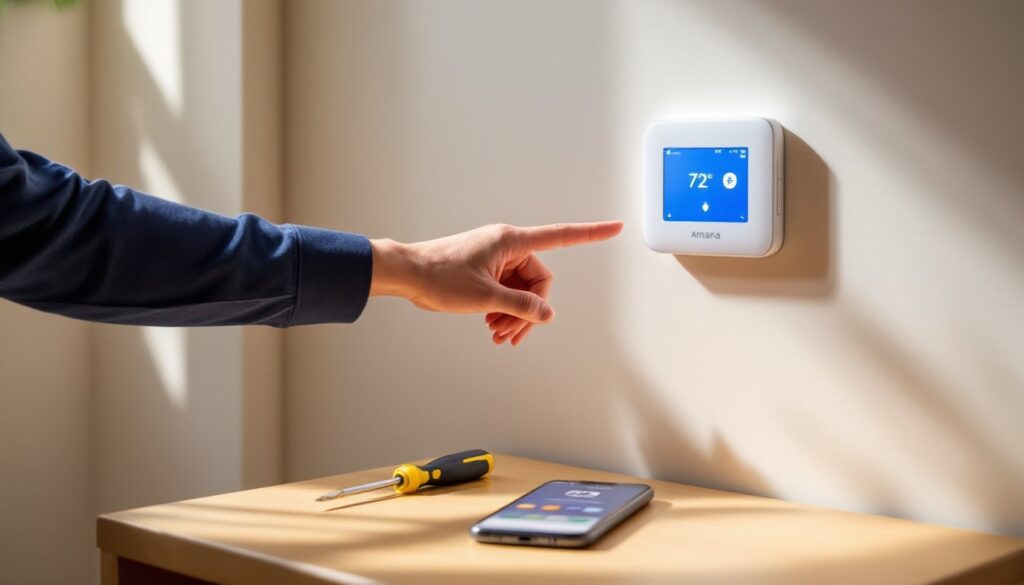
Gather your materials and tools before pulling the old thermostat. You’ll need:
- Phillips screwdriver (for terminal screws and mounting)
- Flathead screwdriver or wire stripper
- Voltage tester or multimeter (non-contact testers work for quick checks)
- Electrical tape and wire labels (masking tape and a pen work in a pinch)
- Drill and level (if relocating or the old plate doesn’t cover wall damage)
- Safety glasses (drilling into drywall can kick up dust)
Turn off power at the breaker or furnace switch, 24VAC can’t shock you badly, but shorting wires can blow the transformer fuse on your HVAC board, which means an expensive service call or a trip to the supply house for a replacement fuse.
Label each wire as you remove it from the old thermostat using the terminal letter (R, C, W, Y, G, etc.). Take a photo with your phone as backup. If wires are unlabeled at the furnace end, you’ll need to trace them or consult your HVAC system’s wiring diagram.
Wiring Your Thermostat to Your HVAC System
Mount the new back plate to the wall using the provided anchors if you’re not hitting a stud. Level it, crooked thermostats are functionally fine but visually distracting. Route wires through the center opening.
Connect wires to the labeled terminals on the Amana back plate. Standard configurations:
- R or Rc: 24VAC power from transformer (usually red wire)
- C: Common return (often blue or black: required for most Amana smart models)
- W or W1: Heat call (white wire)
- Y or Y1: Cooling call (yellow wire)
- G: Fan (green wire)
- W2/Y2: Second-stage heat/cool (if your system has it)
- O/B: Reversing valve control for heat pumps (orange or blue: set O or B in thermostat configuration based on your unit)
- Aux/E: Auxiliary or emergency heat (often marked with a different color or second white wire)
If you have a heat pump with auxiliary electric strips, you’ll typically see R, C, Y, G, O/B, and Aux wired. Conventional gas furnace with AC uses R, C, W, Y, G. For detailed wiring diagrams, the installation guide provides model-specific terminal assignments.
Don’t force thick 18-gauge wire into terminals, trim and strip about 1/4 inch of insulation. Tighten terminal screws snugly but don’t overtorque and crack the plastic housing. Snap the display onto the back plate and restore power at the breaker.
Programming and Configuring Your Amana Smart Thermostat
After powering on, the thermostat will walk through an initial setup wizard. You’ll select system type (heat pump, gas furnace, etc.), number of heating and cooling stages, and whether you have auxiliary heat. Getting this wrong means the thermostat won’t call the right equipment, if you set it for a single-stage furnace but have two-stage, the second stage will never fire.
Set the heat/cool differential (the temperature swing before the system cycles). Most units default to 1°F, which is fine for modern variable-speed systems. Single-stage equipment may benefit from a wider swing (1.5–2°F) to reduce short-cycling and compressor wear.
Create a 7-day schedule or use preset profiles (Home, Away, Sleep). Amana thermostats let you set up to four periods per day. Typical energy-saving schedules drop the heat setpoint by 8–10°F during sleep and work hours, and raise cooling setpoints by 7–10°F when away. Each degree of setback saves roughly 1% on heating costs over an eight-hour period, according to Department of Energy estimates (actual savings vary by climate zone, insulation, and equipment efficiency).
Enable adaptive recovery if available, this feature learns how long your system takes to reach setpoint and starts heating or cooling early so the target temperature is hit exactly at the scheduled time, rather than starting the ramp at the scheduled time.
For ComfortBridge systems, you’ll configure fan speed profiles and humidity targets directly in the thermostat. Standard AST models control fan via the G-wire only and don’t modulate blower speed.
Connecting to Wi-Fi and Smart Home Integration
Press the Menu button and navigate to Wi-Fi settings. Amana smart thermostats support 2.4 GHz Wi-Fi only, if your router broadcasts a combined 2.4/5 GHz network with the same SSID, you may need to temporarily disable the 5 GHz band or create a separate 2.4 GHz guest network during setup.
Enter your network password using the on-screen keyboard. Patience helps here, touchscreen keyboards on budget thermostats can be sluggish. Once connected, the thermostat will prompt for a firmware update. Let it complete: updates often fix connectivity bugs and add features.
Download the Amana Home app (iOS/Android) and create an account. Add your thermostat by scanning the QR code on the back plate or entering the MAC address manually. The app mirrors on-device controls and adds geofencing (temperature adjustments based on your phone’s location) and usage reports.
Amana smart thermostats integrate with Amazon Alexa and Google Assistant for voice control. Link the Amana Home skill in the Alexa app or add the device in Google Home. You can issue commands like “set the thermostat to 68 degrees” or “turn on the fan.” As of 2026, Amana does not natively support Apple HomeKit or Matter protocol, though this may change with future firmware.
Many smart home platforms reviewed on Digital Trends highlight Wi-Fi thermostat compatibility as a key feature when building an integrated system. If you’re running Home Assistant or another open-source hub, Amana thermostats using the Daikin Cloud API can sometimes be added via community integrations, though official support is limited.
Common Troubleshooting Issues and Solutions
Thermostat displays “No power” or shuts off intermittently: Check the C-wire connection at both the thermostat and the furnace control board. Measure voltage between R and C with a multimeter, should read 24VAC ±10%. If it’s low or absent, the transformer may be failing or the fuse on the control board is blown. A blown fuse usually indicates a short (wires touching) somewhere in the system.
System won’t heat or cool: Verify the thermostat is set to the correct mode (Heat/Cool/Auto) and the setpoint is at least 2°F away from current temperature. Check that the circuit breakers for both the air handler and outdoor unit are on. If the system runs but doesn’t reach temperature, the issue is likely equipment-side (low refrigerant, failed ignitor, clogged filter) rather than the thermostat.
Wi-Fi won’t connect or drops frequently: Confirm you’re using a 2.4 GHz network. Move your router closer or add a Wi-Fi extender if the thermostat is in a basement or exterior wall with poor signal. Restart the thermostat by pulling it off the back plate for 30 seconds, then reattach. Reflash firmware if updates were interrupted. Testing across various smart home setups, experts at CNET often note weak wireless radios in budget-tier thermostats as a recurring complaint.
Screen is blank but system runs: The thermostat may be receiving power through Y, W, or G terminals (which can provide partial power in some configurations) but missing the R or C-wire. Double-check all connections. If you added a C-wire adapter, ensure the adapter’s leads are landed on the correct terminals at the furnace board.
Incorrect temperature readings: Thermostats mounted on exterior walls, above vents, or in direct sunlight will read inaccurately. Relocate to an interior wall about 52–60 inches off the floor, away from drafts and heat sources. Some Amana models allow a temperature offset in advanced settings to calibrate the reading without moving the unit.
Error codes (E1, E2, etc.): Consult the Quick Reference card that shipped with your unit or the online manual for your model number. E1 often indicates open sensor wiring, E2 points to a shorted sensor. If error codes persist after verifying wiring, the internal sensor may be faulty, warranty replacement is usually the fix.
Professional help: If you’re facing repeated blown fuses, error codes that don’t clear, or your system requires zoning dampers or multi-stage modulating equipment, call an HVAC tech. Thermostat installation is DIY-friendly for standard systems, but complex setups or electrical issues beyond the low-voltage wiring warrant a licensed pro. Permits are rarely required for thermostat replacement alone, but if you’re adding a C-wire that involves running new wire through finished walls or modifying the furnace board, local codes may apply.