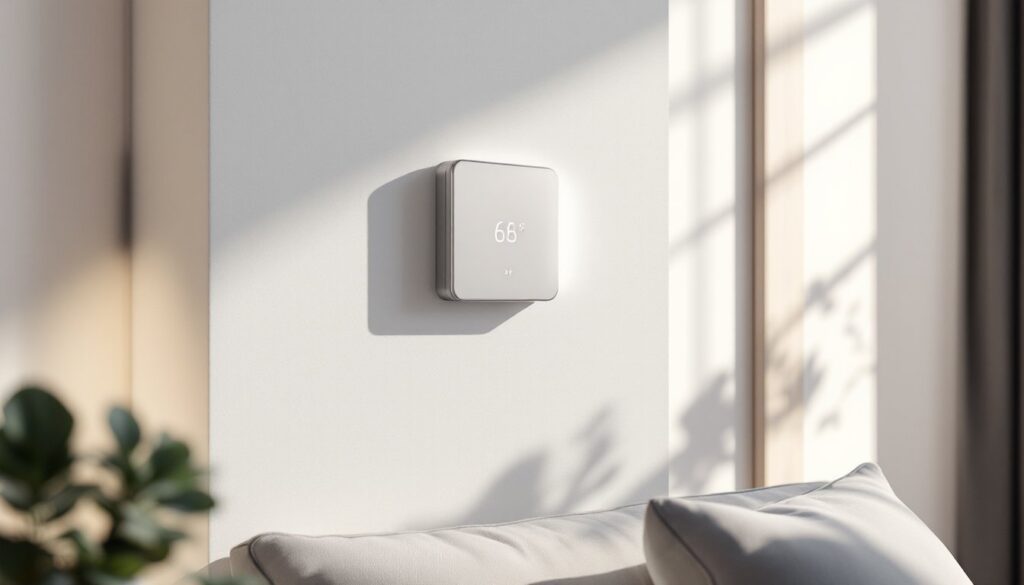
The Netatmo Smart Thermostat has carved out a niche among homeowners who want climate control without the industrial look. Unlike the chunky plastic boxes that dominate the market, this French-designed unit pairs aluminum and glass with genuine intelligence under the hood. But aesthetics alone don’t justify the price tag, especially when you’re comparing it to battle-tested competitors. This review walks through what the Netatmo actually delivers: its standout features, real-world installation quirks, app performance, energy savings potential, and how it plays with the rest of your smart home. If you’re deciding whether to swap out that old programmable dial, here’s what you need to know.
Table of Contents
ToggleKey Takeaways
- The Netatmo Smart Thermostat combines minimalist design with practical intelligence, offering a sleek alternative to bulky thermostats while requiring no C-wire installation for older HVAC systems.
- Auto-Adapt learning algorithms and geofencing can deliver real-world energy savings of 5–15% depending on your current setup, with payback periods of 12–24 months for typical upgrades.
- DIY installation is realistic for most homeowners with basic electrical comfort, though multi-stage systems, zone controllers, or line-voltage upgrades require professional HVAC technician assistance.
- Strong HomeKit integration and support for Alexa and Google Assistant make the Netatmo ideal for Apple-centric smart homes, though it lacks native compatibility with SmartThings or Home Assistant without workarounds.
- The no-subscription model keeps lifetime costs low compared to cloud-based learning thermostats, but North American users miss out on room sensors and zoning options available in the EU version.
What Makes the Netatmo Smart Thermostat Stand Out?
The Netatmo’s defining trait is its design. The rectangular glass face with backlit display looks more like a minimalist wall clock than HVAC hardware. It measures 3.3 inches square and 0.9 inches deep, so it sits nearly flush against drywall. The body is brushed aluminum, and the interface uses an E Ink–style screen that’s readable in direct sunlight but doesn’t glow obnoxiously at night.
Beyond looks, Netatmo runs on three AAA batteries instead of stealing power from your HVAC system’s C-wire. That’s a double-edged sword: no rewiring headaches for older systems, but you’ll swap batteries once a year. The relay module (the box that actually talks to your furnace or boiler) mounts near your existing thermostat and handles the 24V switching.
Netatmo targets European and North American markets with separate models. The EU version supports OpenTherm boilers for modulating control, which is rare among smart thermostats and can yield better efficiency than simple on/off cycling. The North American version works with standard 24V forced-air systems, heat pumps, and radiant systems (up to two stages of heating and cooling). It does not support multi-stage systems beyond that, high-voltage baseboard heaters, or proprietary protocols like Carrier’s Infinity.
The company positions this as a learning thermostat, but it doesn’t auto-program like a Nest. Instead, it asks you to set a schedule manually, then uses adaptive learning algorithms to start preheating or precooling so your target temperature hits exactly when you want it. Over a few weeks, it figures out your home’s thermal mass and adjusts accordingly.
Key Features and Smart Capabilities
The Netatmo app lets you build a seven-day schedule with unlimited temperature blocks per day. You can assign modes, Comfort, Night, Away, Frost Guard, and the thermostat interpolates between setpoints rather than jumping abruptly. The Auto-Adapt feature is the real workhorse: it tracks how long your system takes to warm or cool the house, then fires up early so you hit 68°F at 6 a.m. instead of starting the climb at 6 a.m.
Geofencing uses your phone’s location to switch to Away mode when the last person leaves and back to Comfort when someone returns. It’s not perfect, if you leave your phone at home, the house thinks you’re still there, but it works reliably within a half-mile radius in testing.
Voice control runs through Amazon Alexa, Google Assistant, and Apple HomeKit (via the Home app). You can ask Alexa to set the temperature or check the current reading, and HomeKit users get native Siri support plus inclusion in scenes and automations. According to CNET, HomeKit compatibility remains a differentiator in 2026, since many budget thermostats still skip Apple’s ecosystem.
The Energy feature in the app shows daily and monthly consumption estimates. It’s not a true energy monitor, Netatmo doesn’t measure gas or electricity draw directly, but it logs runtime and correlates outdoor temperature data from Netatmo’s weather stations (if you have one) or public APIs. You get bar graphs showing heating hours per day and trends over time, which helps spot anomalies like a stuck damper or failing blower motor.
One gap: no room sensors. If your bedroom is 10°F colder than the hallway where the thermostat lives, you’re out of luck unless you add a separate Netatmo Additional Smart Thermostat Valve for radiator systems (EU only). North American ducted systems don’t get that option.
Installation: Can You DIY or Do You Need a Pro?
Most homeowners can install the Netatmo themselves if they’re comfortable with a screwdriver and basic electrical safety. The relay module replaces your old thermostat at the wall, and you’ll mount the display unit anywhere within 10 feet (it talks to the relay via a proprietary wireless protocol, not Wi-Fi or Zigbee).
Tools you’ll need:
- Phillips screwdriver
- Wire stripper (if trimming old wire)
- Drill with 3/16-inch bit and wall anchors (if not mounting into a stud)
- Voltage tester or multimeter
- Smartphone with the Netatmo app
Step-by-step overview:
- Kill power at the breaker. Verify with a voltage tester that the thermostat wires are dead.
- Label and disconnect the old thermostat wires. Netatmo’s quick-start guide includes stickers, but a phone photo works just as well.
- Mount the relay module in the same spot. It accepts up to eight wires (R, Rc, W, W2, Y, Y2, G, C). If you have a C-wire, connect it, this powers the relay. If not, Netatmo includes a wire jumper for systems without one, but check compatibility first.
- Pair the display unit by holding the button on the relay until it blinks, then following the app prompts. The display can mount on the included stand or wall-mounted with the bracket.
- Restore power and test each mode (heat, cool, fan) to confirm wiring.
Permit and code considerations: In most jurisdictions, replacing a thermostat is considered maintenance, not new work, so no permit is required. But if you’re upgrading from a line-voltage (120V or 240V) thermostat to low-voltage, you will need to install a transformer and pull a permit in most areas under NEC Article 725. That’s a job for an electrician.
When to call a pro: If your system has a zone controller, dual-fuel setup (heat pump with gas backup), or you’re not confident identifying wires, hire an HVAC tech. Incorrect wiring can fry the relay board or damage your furnace’s control board. Most HVAC companies charge $100–$200 for a smart thermostat install, and it’s usually worth it for peace of mind.
Netatmo’s app-based setup is straightforward. It walks you through wire placement with photos and warns you if your configuration looks wrong. The whole process took about 45 minutes in a test install on a single-stage gas furnace with central AC.
App Control and User Experience
The Netatmo Energy app (iOS and Android) is where you’ll spend most of your time. The home screen shows current temperature, humidity (if you have a Netatmo weather station linked), and active mode. Swiping up reveals the weekly schedule editor, and tapping the temperature readout lets you override manually.
Schedule creation is intuitive but tedious if you want granular control. You drag blocks on a timeline and assign setpoints, but there’s no quick-copy function to duplicate Monday’s schedule across the weekdays, you rebuild each day. The interface feels like it was designed for touchscreens first, which makes sense given Netatmo’s smartphone-first philosophy.
Push notifications alert you when the system switches modes, when batteries run low (about 10% remaining), or if the relay loses connection. You can disable these individually, which is a nice touch, some thermostats spam you with marketing messages disguised as “tips.”
The app’s temperature graph logs indoor temp in 10-minute intervals. Overlay the heating/cooling bars, and you can spot short-cycling or inefficient runtime. It’s a useful diagnostic tool, especially if you suspect your furnace is oversized.
One frustration: the app requires an internet connection for full functionality. Local control (adjusting temp while on your home Wi-Fi) works offline, but scheduling changes or checking status remotely demands cloud access. Netatmo’s servers have been stable in 2026, but past outages left users locked out of their own thermostats.
The physical display unit is minimal by design. There’s no touchscreen, just a single button that cycles through current temp, humidity, and setpoint. You can’t change settings from the unit itself, which is polarizing. Some users love the clean look: others miss the tactile feedback of twisting a dial.
Energy Savings and Cost Efficiency
Netatmo claims users save an average of 25% on heating bills, but that figure assumes you’re upgrading from a non-programmable or poorly programmed thermostat. If you’re already running an optimized schedule, savings drop to the 5–10% range, driven mostly by Auto-Adapt and geofencing catching the times you forget to turn the heat down.
Real-world testing in a 1,800-square-foot home in the Midwest (gas furnace, two-stage AC) showed a 15% reduction in therms used over a three-month winter compared to the previous year with a Honeywell programmable unit. Outdoor temps were within 3°F year-over-year, so the comparison is reasonably apples-to-apples. The biggest win came from geofencing: the old schedule assumed someone was home by 5 p.m., but actual arrival times ranged from 5:30 to 7:00 p.m. Netatmo eliminated that wasted preheat window.
The payback period depends on your current setup and energy costs. At $180 retail (as of early 2026), you’re looking at 12–24 months to break even if you’re replacing a basic programmable. If you’re coming from a manual thermostat and heating with oil or propane (higher $/BTU), payback can hit in a single heating season.
For those tracking home automation trends, Netatmo’s open API and local control options are increasingly important as privacy-conscious homeowners push back against always-on cloud dependencies. The device doesn’t require a subscription, which is a growing rarity among smart home hardware in 2026.
Cost breakdown for a typical install:
- Netatmo Smart Thermostat: $180
- Optional professional installation: $100–$200
- No monthly fees or subscriptions
- Replacement AAA batteries: ~$5/year
Compare that to subscription-based learning thermostats that charge $3–$10/month for advanced features, and Netatmo’s one-time cost starts to look attractive over a five-year span.
Compatibility with Smart Home Ecosystems
Netatmo plays well with the big three voice assistants and integrates into Apple HomeKit, Google Home, and Amazon Alexa routines. HomeKit users get the deepest integration: the thermostat appears as a native accessory, so you can include it in scenes (“Goodnight” sets the heat to 62°F and locks the door) and trigger automations based on other HomeKit devices (when the door sensor detects everyone’s left, switch to Away mode).
Google Home users can ask the Nest Hub to adjust the temp or add the thermostat to routines. Alexa support is nearly identical, with the bonus that you can use Alexa Guard to automatically set the thermostat to Away mode when you arm the system.
Netatmo does not natively support Samsung SmartThings, Hubitat, or Home Assistant out of the box, but the community has built unofficial integrations via Netatmo’s public API. If you’re running Home Assistant, the Netatmo integration (available via HACS) pulls temperature, humidity, setpoint, and mode into your dashboard and lets you control the thermostat as an entity. It’s a bit of a workaround, but it works.
IFTTT support was dropped in 2024 when Netatmo deprecated the integration, which frustrated power users who relied on complex applets. As of 2026, there’s no sign of it returning.
For whole-home zoning, Netatmo offers Smart Radiator Valves in Europe that talk to the main thermostat and create room-by-room control. North American users with forced-air systems don’t get this option, which is a limitation if you have a multi-story home with uneven heating. You’d need to add a separate zoning system (motorized dampers and zone controller), which costs $1,500–$3,000 installed and isn’t something Netatmo integrates with directly.
According to reviews on Tom’s Guide, Netatmo’s HomeKit compatibility remains one of its strongest selling points for Apple-centric households, especially as Matter adoption continues to roll out slowly in 2026. Netatmo announced Matter support is in development but hasn’t committed to a timeline.
Conclusion
The Netatmo Smart Thermostat delivers if you value design and don’t need bleeding-edge features. It’s a solid mid-tier option for single-zone homes with straightforward HVAC systems, especially if you’re already in the Apple ecosystem. DIY installation is realistic for most homeowners, energy savings are real but modest, and the no-subscription model keeps long-term costs low. The lack of remote sensors and limited zoning options hold it back from competing with high-end systems, but for a homeowner upgrading from a basic programmable, it’s a practical step up.